

Power Bank Capacity Explained: Why mAh Alone Cannot Tell You the Number of Charges
Compare watt-hours, output ratings and charging losses—not just two mAh numbers. A worked example explains the arithmetic without promising a fixed number of phone charges.

Maintained by FindsRadar Editorial Team
Start with energy, not a promised charge count
A 10,000mAh label does not establish a fixed number of phone charges. The phone’s battery energy, charging losses and use while connected all matter. Compare watt-hours (Wh) at the relevant battery voltage rather than dividing mAh figures measured at different voltages.
Wh = mAh × nominal voltage ÷ 1,000. Use the voltage paired with the stated battery capacity, not an arbitrary USB output voltage. The 3.7V value below is an example, not a universal power-bank specification.
A worked example: 10,000mAh at 3.7V
For an illustrative 10,000mAh battery at 3.7V, stored energy is 10Ah × 3.7V = 37Wh. At a 5V output, the ideal charge equivalent is 37Wh ÷ 5V = 7.4Ah, or 7,400mAh. That change in mAh alone is not energy lost: the voltage is different.
If the conversion delivered 85–90% of that energy, it would provide 31.45–33.3Wh, equivalent to 6,290–6,660mAh at 5V. These are assumed efficiencies, not measured performance or a guarantee for the photographed device. Further losses and the phone’s own power use affect energy stored in its battery.
What to check on the actual product
Look for the exact model’s battery Wh rating and rated output capacity, including its voltage and test conditions. Do not assume every output profile has the same efficiency. A larger mAh number also does not establish charging speed or compatibility.
For a rough charge-count estimate, compare energy actually available to the phone with the phone battery’s Wh capacity. The result remains an estimate, not a fixed outcome. Check manufacturer documentation and relevant measured tests before relying on a particular runtime.
This is a documentation-based explanation, not a hardware test or product recommendation. For flying, separately check your operating airline’s current battery policy; the arithmetic here does not establish baggage approval.
Sources & image credits
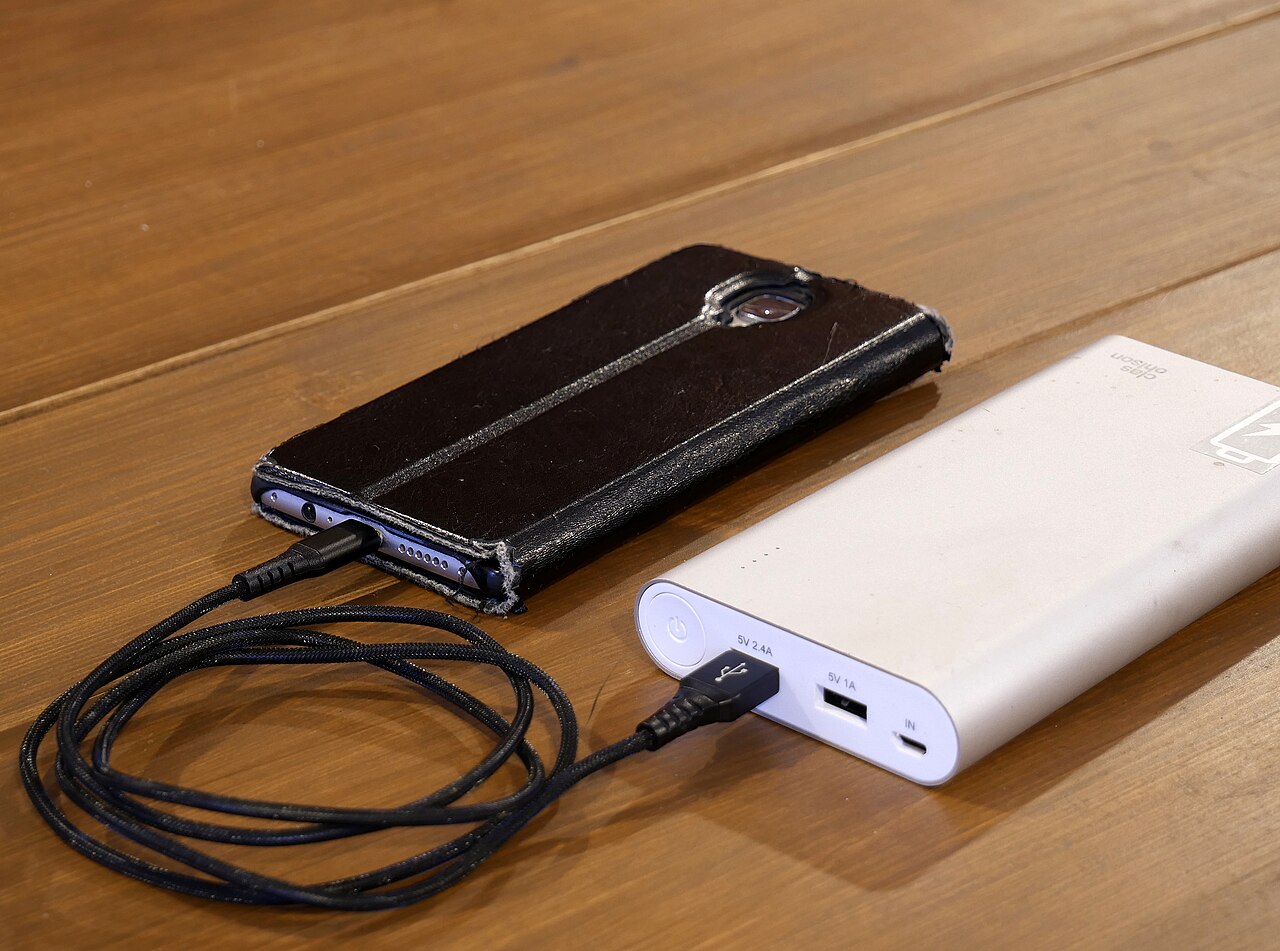
A real power bank connected to a phone, photographed in 2018. Context image only: not the 10,000mAh worked example, a tested recommendation or a current offer.
Image: Santeri Viinamäki / Wikimedia Commons · CC BY-SA 4.0. Wikimedia 1280px resized version; no further crop or retouching. Licensed under CC BY-SA 4.0; no photographer endorsement implied.
Related Stories & Reviews
Carry-On Tech Packing: Check Bag Size, Charger Compatibility and SSD Requirements
Source product image · Not FindsRadar hands-on testing.
6 min read
Why Cheap Charger Cables Kill Your Smartphone Battery: Testing 60W PD, GaN & Multi-Cables
Intact cable examples · Not damage or battery-failure evidence.
9 min read